


Amazon AMZN 0.00%↑ caught my attention in Sunday’s Market Playbook when it was trading around $242, roughly 14% below Morningstar’s $280 fair-value estimate.
By Tuesday’s close, AMZN had climbed to $250.69.
That’s a gain of approximately 3.6% in two trading sessions, and the discount to Morningstar’s fair value has narrowed to 10.5%, but here’s where I want to look a little closer.
Morningstar currently rates AMZN 3 stars, meaning it considers the stock fairly valued despite that discount.
Technically, AMZN has reclaimed its 5-day EMA, but it remains below its 20-day SMA. That’s encouraging short-term progress, not confirmation of a sustained recovery.
And beyond the chart, there’s a bigger question: AMZN’s AI business is growing rapidly, but so is the amount of money the company is spending to support that growth.
So now that AMZN has bounced, is there still enough opportunity here to justify the risk—or would a more convincing technical setup make it worth the wait?
Here’s the setup →

NIM Top Pick of the Week 👑
Ticker: AMZN 0.00%↑
Company: Amazon.com, Inc.
Sector: Consumer Discretionary XLY 0.00%↑
Industry: Broadline Retailers
Valuation: Morningstar currently rates AMZN three stars with a $280 fair-value estimate.
Dividend: No.
Potential swing-trade target: previous high of $280-285
👑 WANT MORE TRADE IDEAS LIKE THIS?
Upgrade to an annual Nurse in the Market subscription.
Paid subscribers get my Sunday Market Playbook, Wednesday Top Pick of the Week, and the research and trade ideas I’m watching along the way.
Come join us. 👑
What’s Driving Amazon’s Growth?
Amazon Web Services (AWS) is giving investors plenty to pay attention to.
In the third quarter of 2026, AWS revenue grew 39% year over year to approximately $46 billion.
Think about that for a second.
We’re talking about a business already generating tens of billions of dollars in quarterly revenue, yet still growing at a rapid pace and artificial intelligence (AI) is becoming a major part of that story.
AWS provides the computing power and technology infrastructure businesses need to build and run AI applications.
AMZN is also developing its own AI chips, including Trainium, and offering tools such as Amazon Bedrock.
In other words, AMZN can make money when other companies spend money building AI, but how much is AMZN spending to make that possible?
The AI Opportunity Has A Hefty Price Tag
AMZN expects approximately $220 billion in cash capital expenditures in 2026, much of it tied to infrastructure expansion.
That’s a lot of money going toward the future and it brings us to a financial detail I think investors should understand.
For the 12 months ended September 30, 2026, AMZN generated approximately $168.3 billion in operating cash flow.
That’s cash generated by its business operations, but after its heavy investment spending, free cash flow was approximately negative $42.4 billion.
Now, that doesn’t mean AWS is losing money. AWS itself is profitable.
It means AMZN is investing so aggressively across its business that its cash spending is outpacing the cash left over from operations.
Here’s how I think about it.
A business can be growing, profitable, and still have negative free cash flow if it’s pouring enormous amounts of money into expansion.
The question is whether that spending eventually delivers a worthwhile return and that’s what I’ll be watching with AMZN.
Can AWS continue growing while Amazon starts converting more of that growth into free cash flow?
Because AI demand is one part of the investment story.
What AMZN ultimately earns from meeting that demand matters just as much.
Amazon Makes Money Even When Someone Else Makes The Sale
When you buy something on AMZN, the company isn’t always the one selling it.
Sometimes you’re buying from an independent seller using Amazon’s marketplace and AMZN can earn revenue at several points along the way.
A seller might pay to advertise a product, pay fees when it sells, and pay AMZN to store, pack, and ship it.
Amazon can make money by helping another business make a sale.
In 2025, AMZN generated approximately $172.2 billion in third-party seller services revenue and $68.6 billion in advertising revenue.
Those are revenue figures, not profits and not every purchase generates every type of fee.
However, here’s why I find the advertising business especially interesting.
Selling and delivering physical products comes with costs: inventory, warehouses, shipping, and returns.
Advertising works differently. AMZN sells businesses the opportunity to get their products noticed by shoppers who are already on its platform.
That doesn’t mean advertising is free money, but it gives AMZN another way to earn revenue without having to sell another physical product itself and that matters as the company looks for ways to grow its business and improve profitability.
👑 LIKE HOW WE BREAK DOWN A TRADE?
Market. Sector. Stock. Setup. Research.
That’s what we do inside Nurse in the Market every week.
Get exclusive acccess to the Sunday Market Playbook, Wednesday Top Pick of the Week, and the trade ideas and research I’m watching in between.
Come trade the Big Picture with us. 👑
Amazon vs. Walmart: What Are Investors Paying For?
Amazon AMZN 0.00%↑ and Walmart WMT 0.00%↑ compete for many of the same customers.
Both sell everyday essentials, offer delivery services, operate membership programs, and earn advertising revenue, but their stock valuations tell two very different stories.
According to Morningstar:
Amazon: Trading approximately 10.5% below its $280 fair-value estimate, with a 3-star rating.
Walmart: Trading approximately 54% above its $81 fair-value estimate, with a 1-star rating.
That’s a pretty big difference.
Now, does it mean AMZN is automatically the better investment?
Nope.
WMT has shown stronger technical momentum, although its RSI has reached extremely elevated levels. AMZN, meanwhile, is still working to confirm a recovery.
And there’s another detail worth noting: Morningstar’s Walmart fair-value estimate dates back to June, while Amazon’s was updated in October.
So I wouldn’t treat these estimates as a perfect head-to-head comparison, but they do raise an important question.
How much future success are investors already paying for?
WMT’s premium suggests investors are willing to pay considerably more than Morningstar’s estimate of its underlying value.
AMZN’s price sits below its estimate, but Morningstar’s 3-star rating tells us the discount isn’t necessarily large enough to compensate for the uncertainty.
Two strong businesses and two very different prices relative to estimated value and that’s worth remembering before deciding which stock deserves your money.
Amazon’s Healthcare Opportunity: My Perspective As A Nurse
As a nurse, I’ve seen patients struggle to afford medications because they don’t have adequate insurance coverage and just because a patient has a prescription doesn’t mean they can afford to fill it.
That’s why AMZN’s growing healthcare business interests me.
Through Amazon Pharmacy, PillPack, and One Medical, the company is expanding into prescription services and healthcare delivery.
But here’s my question.
Can Amazon make medications more affordable, or is it mainly making them more convenient to get?
AMZN offers prescription savings options and delivery services that may help some patients, but convenience alone doesn’t solve the problem of inadequate insurance coverage or expensive medications.
From an investment perspective, I see healthcare as a longer-term opportunity for AMZN—not a proven reason to buy the stock today.
As both a nurse and an investor, I’ll be watching whether AMZN can improve access for patients while building a financially sustainable business.
AMZN chart annotation →
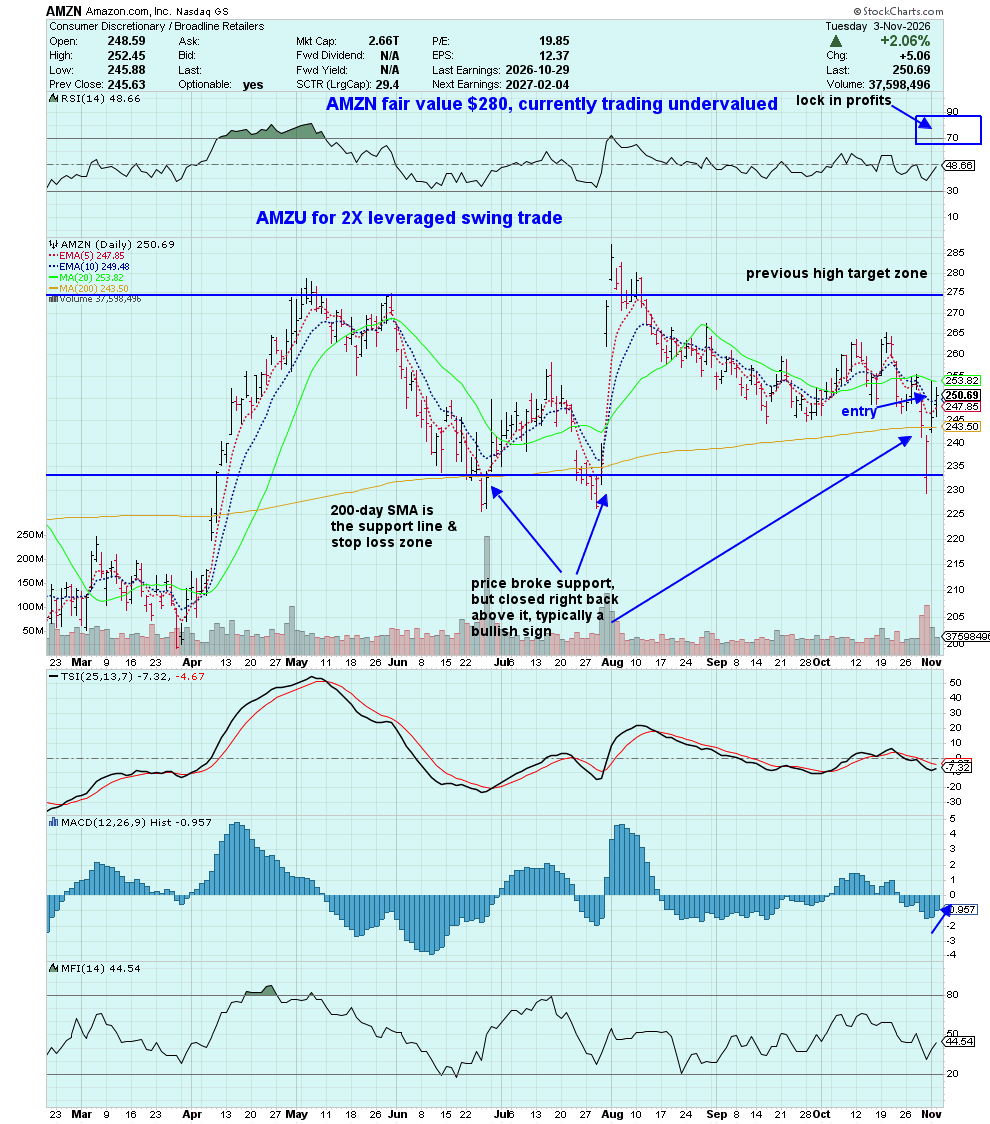
AMZN’s Technical Picture: Is the Bounce Enough? 📈
AMZN has made some progress since I featured it in Sunday’s Market Playbook.
At Friday’s close, AMZN was trading around $242. By Tuesday, November 3, it had climbed to $250.69, a gain of approximately 3.6%.
That’s encouraging. But one strong bounce doesn’t automatically mean a stock has turned the corner.
On Tuesday, AMZN closed above its 5-day EMA but remained below its 20-day SMA, currently around $253.82.
The 5-day EMA responds quickly to recent price changes, so reclaiming it can be an early sign of improving short-term momentum.
The 20-day SMA gives us a broader view of the recent trend and AMZN hasn’t reclaimed it yet.
What I’m Watching Next
First, can AMZN hold above its 5-day EMA?
That would help show whether the recent improvement in short-term momentum has staying power.
Second, can it reclaim $253.82?
As of Tuesday’s close, AMZN’s 20-day SMA stood at $253.82, making it the next technical level I’m watching. I’d like to see AMZN close above it and then hold that level, rather than briefly crossing it and falling back below.
Moving averages change as new prices come in, so $253.82 is a reference point, not a permanent resistance level.
If AMZN loses its 5-day EMA again, I’d be more cautious about the bounce.
AMZN’s business gives me plenty of reasons to keep watching, but with Morningstar currently rating the stock fairly valued, I’m not interested in chasing a move before the chart offers stronger confirmation.
For now, $253.82 is the next technical hurdle I’m watching—not an automatic buy signal.

The Bottom Line
Amazon AMZN 0.00%↑ remains a stock I’m watching closely.
AWS is growing rapidly, AI presents a significant long-term opportunity, and AMZN’s retail and advertising businesses give it multiple ways to generate revenue, but a strong business doesn’t automatically mean the stock is a bargain.
AMZN’s enormous capital spending is putting pressure on free cash flow, and Morningstar’s 3-star rating suggests the stock is fairly valued, even at a price below its $280 fair-value estimate and after the bounce we saw following Sunday’s Market Playbook, I’m not interested in chasing AMZN without stronger technical confirmation.
My next checkpoint is the 20-day SMA, which stood at $253.82 as of Tuesday’s close. I want to see AMZN reclaim that level and hold it while maintaining support above its 5-day EMA.
For now, I’m keeping AMZN on my watchlist.
I like what Amazon is building. I just want the price, valuation, and chart to give me a better reason to act.
Following a systematic approach, reading market structure, and staying disciplined compounds over time.
Let me know what you’re watching and thank you so much for reading! 🙌
-Nurse Jess 🤝
Know the Big Picture. Focus on the Edge. 👑
Recent Top Picks of the Week
Top Pick of the Week: A Rare Bright Spot in a Weak Market

Sometimes the best trade is the one you don’t take.


📌 Bookmark this post. Track these setups through the week and see how they play out. This is how you develop an edge—by studying real-time trade ideas and learning what works.
Financial Disclaimer: This is not financial advice. All trades carry risk. Biotech stocks are highly volatile and speculative. Always do your own due diligence and consult with a financial advisor before making investment decisions.
Scan the QR code below to subscribe to Nurse in the Market →

👑 AMZN is growing, but is the stock ready?
AWS growth is impressive, but Amazon's massive AI spending, negative free cash flow, and Morningstar's 3-star rating give us plenty to think about.
I'm watching whether AMZN can reclaim and hold its 20-day SMA, which stood at $253.82 on Tuesday.
What about you? Are you buying AMZN at these levels, waiting for a better entry, or staying on the sidelines? 👇📈